
Have you ever struggled to understand the judicial hardening of men in the Bible such as Pharoah, or even Judas Iscariot, Christ’s betrayer? Perhaps you are wondering about the backsliding or coldness of a beloved brother or sister in Christ.
Based on Puritan John Owen’s renowned work, Mortification of Sin, we have tabulated the cause, means, and remedy — or lack of remedy — for each kind of hardness of heart that we read about in Scripture. Every heart, apart from grace, carries some measure of hardness — but not all hardness is the same.
As you read through the comparison below, consider:
- Am I grieved by my own coldness toward God's word — or untroubled by it?
- Am I resisting the "supplies of light" God has given me, or am I asking Him to keep my heart tender?
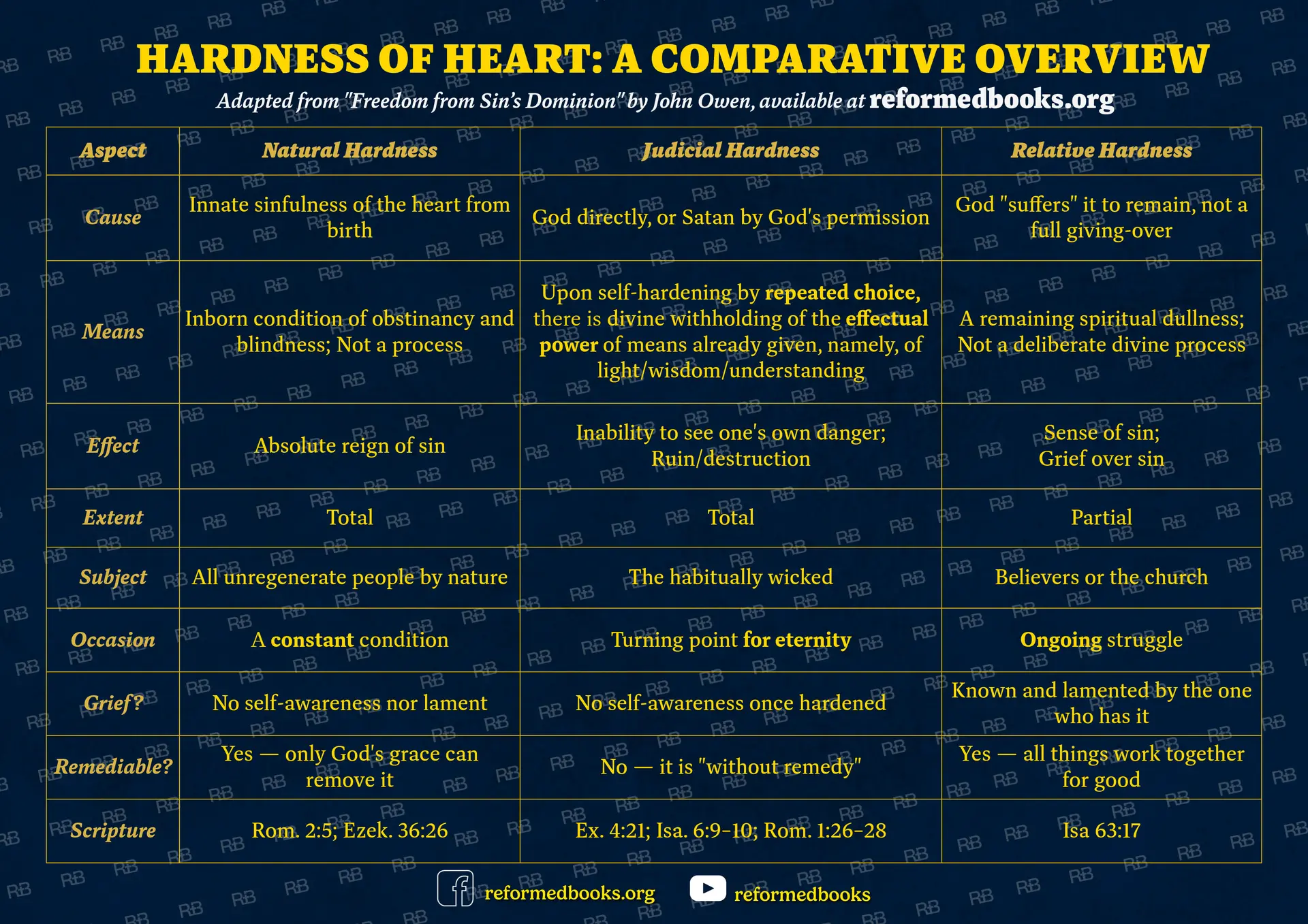
Read the excerpt from Chapter 8 in RHB’s edition of John Owen’s work:
Two Kinds of Hardness of Heart
Hardness of heart can be either total and absolute or partial and only relative.
Total Hardness of Heart
Total hardness can be either natural and universal or judicial in some particular individuals. Natural hardness is the blindness or obstinacy of the heart in sin by nature. This cannot be cured by the use or application of any outward means; Paul speaks of their "hardness and...impenitent heart" (Rom. 2:5). This is the heart of stone, which, in the covenant, God promises to take away by the power of His almighty grace (Ezek. 36:26). Where this hardness remains uncured and unremoved, there sin is absolutely on the throne. This is not the kind of hardness now under consideration.
Freedom from Sin's Dominion
Judicial hardness comes either immediately from God or through the devil by God's permission. First, it can come directly from God, who is frequently said to harden the hearts of men in their sins, leading to their ruin, as in the case of Pharaoh (Ex. 4:21). Generally, He does this in two ways: first, by withholding from them those supplies of light, wisdom, and understanding without which they cannot understand their condition, see their danger, or avoid their ruin; second, by withholding the effectual power of the means to which they do have access — indeed, He gives them an efficacy leading to their hardening (Isa. 6:9–10).
There are several things we may observe concerning this divine process of hardening: It is the most severe divine punishment that takes place in this world. Therefore, it is only executed toward those who are habitually wicked, who by their own choice harden themselves in their sins (Rom. 1:26–28). It usually concerns particular times and seasons that are turning points for eternity. The condition of those who are hardened in this way is without remedy; their wounds are incurable. When any are hardened in this way, there is no question but that [this is judgment].
Partial Hardness of Heart
But there is also a hardness of heart that is only partial and relative, even though it may appear to be total and absolute. This is why we must inquire whether or not hardness of heart is evidence of sin's dominion.
There is a kind of hardness of heart that is known and lamented by those who have it. The church complains of this in Isaiah 63:17: "O LORD, why have You made us stray from Your ways, and hardened our heart from Your fear?" Or, as the sense may be, Why have You suffered it to be so, rather than healing and recovering us from our hardness? And there are various things that work together in this kind of hardness of heart.
The Heart Lacks Readiness to Receive God's Word
When the heart is soft and tender, it is also humble and contrite and ready to tremble at God's word. So it was said of Josiah that his heart was tender and he humbled himself before the Lord when he heard His word.